

The fire drill log
The log is one page for a whole year of drills at a site: a row for each drill with the date, the type, the scenario, how long it took, what went wrong and who signed it off.
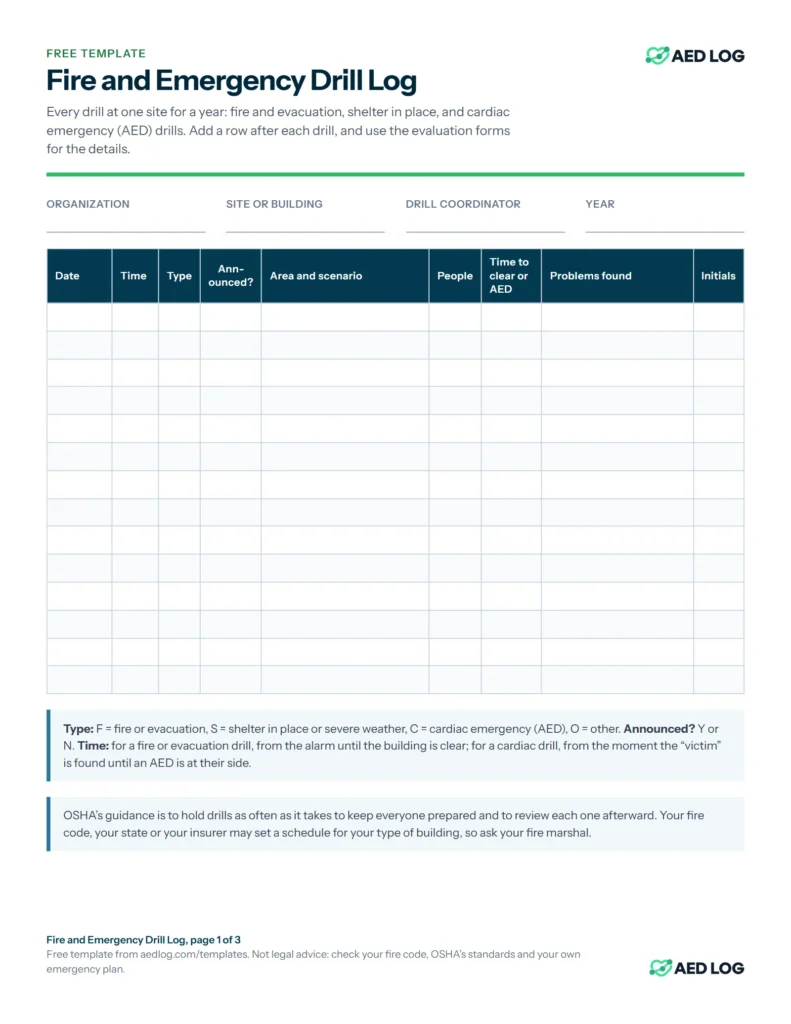
A drill is only useful if you learn something from it, and a log is how you see the pattern: the alarm nobody heard in the warehouse, the exit that was blocked twice, the AED that took four minutes to arrive. Write a row after every drill, whether it went well or not.
The log covers four kinds of drill, each with a one-letter code: F for a fire or evacuation drill, S for shelter in place or severe weather, C for a cardiac emergency (AED) drill, and O for anything else, such as a lockdown or a chemical spill. The time column means something different for each. For a fire drill, it runs from the alarm until the building is clear. For a cardiac drill, it runs from the moment someone finds the “victim” until an AED is at their side.
Pages two and three are evaluation forms, one for fire and evacuation drills and one for cardiac drills. Fill one in during each drill, then copy the headline numbers onto the log.
What to record for each drill
Record when the drill happened, what kind it was, where, who took part, how long it took, what went wrong and who will fix it.
- Date and time, and whether the drill was announced. Unannounced drills show what people really do; announced ones are better for teaching a new plan.
- Type and scenario: the kind of drill, the area, and what you pretended had happened.
- Who took part: how many people, and who led and evaluated the drill.
- The timeline: clock times for the alarm, the last person out, the head count and the all clear, or for each step of a cardiac response.
- Problems and fixes: what went wrong, what you’ll change, who owns each fix and the date it’s due.
- Sign-off: the evaluator’s signature and the date the results were reviewed with staff.
OSHA’s emergency action plan rule, 29 CFR 1910.38, doesn’t require drills, so it has no rule for recording them either. Keep the log with your emergency action plan anyway: it’s the easiest way to show a fire marshal, an insurer or an auditor that the plan is practiced, not just written.
How often to hold fire drills
OSHA doesn’t set a drill schedule for most workplaces. Its guidance is to hold drills as often as it takes to keep employees prepared, and your fire code, your state or your insurer may set a schedule for your type of building.
When another OSHA standard calls for an emergency action plan, 29 CFR 1910.38 sets out what the plan must cover and requires training employees on it, but drills aren’t one of its required elements. OSHA’s Evacuation Plans and Procedures eTool recommends them all the same: it calls practice evacuation drills a good idea, says to run them as often as needed to keep people ready, suggests bringing in the fire and police departments where you can, and says to evaluate each drill with managers and employees afterward. The same eTool suggests retraining employees every year.
Fire codes are where most drill schedules come from. States and cities adopt a fire code, often based on the International Fire Code or NFPA 101, and these require evacuation drills on a set schedule for some kinds of buildings, such as schools and health care facilities. The schedule depends on the code your area adopted and on the type of building, so ask your local fire marshal what applies to yours.
Cardiac drills have schedules of their own in some places. Texas’s 2025 school law, SB 865, requires every school district’s cardiac emergency response plan to include annual practice drills, and federal guidelines for AED programs in government buildings recommend a mock drill every year. If nothing else sets your schedule, hold at least one evacuation drill and one cardiac drill a year, and more often when people or the building change.
How to run and evaluate a drill
Choose a scenario, warn the people who need to know, run the drill and time it, then get everyone together afterward to agree on what to fix.
- Pick the drill and the scenario: a fire in a particular area, severe weather, or someone collapsing in a particular room.
- Tell your alarm monitoring company before you set off the alarm, so the drill isn’t reported as a real fire, and invite your local fire department if they’re willing to watch.
- Give an evaluator the evaluation form and a watch, and if you can, put a helper at each exit or assembly area.
- Start the drill and time it: from the alarm until the building is clear, or from the moment the “victim” is found until an AED is at their side.
- Take the head count at the assembly area, including visitors and contractors, and give the all clear.
- Soon afterward, get managers and the people who took part together to talk through what worked and what didn’t.
- Write down each fix, who owns it and when it’s due, then add the drill to the log.
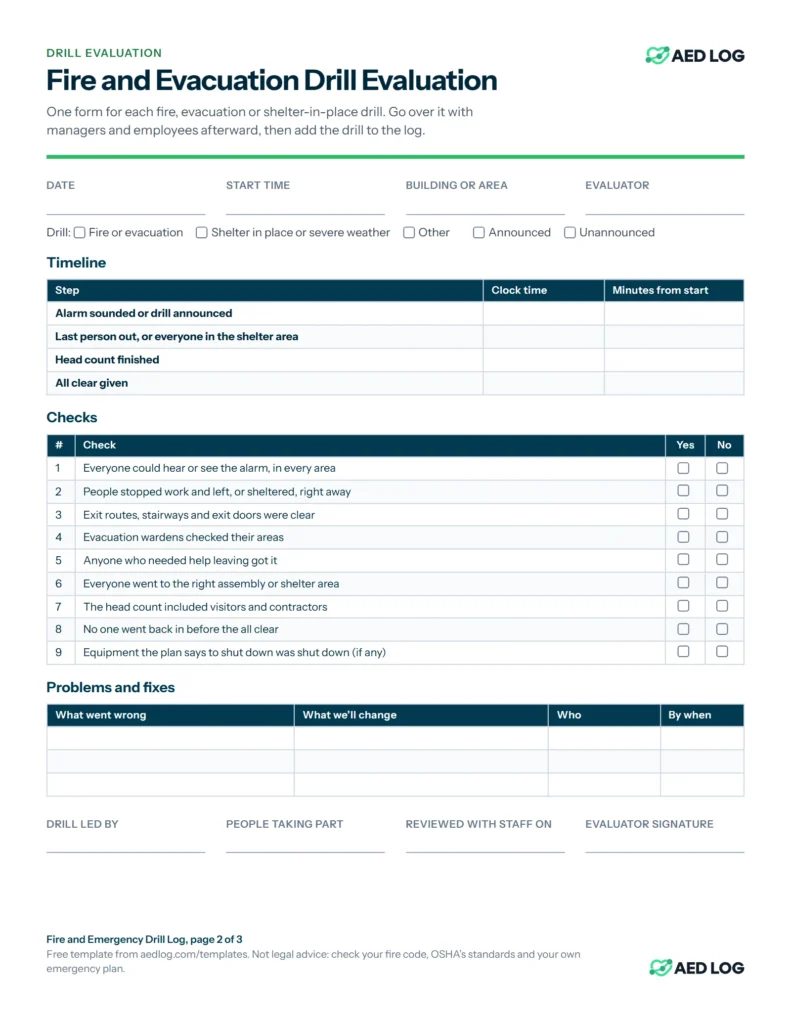
The fire and evacuation form has nine checks, from whether everyone could hear or see the alarm to whether anyone went back in before the all clear. A No on any of them is the start of a fix, not a failure: that’s what the drill was for. Count visitors and contractors in the head count too. OSHA requires the plan to account for every employee after an evacuation, and its eTool says visitors should be accounted for as well, which is why sign-in sheets matter.
For what your plan needs to say about exits, assembly areas and evacuation wardens before you drill it, see our free OSHA emergency action plan template.
Cardiac emergency (AED) drills
A cardiac drill practices the part of your emergency plan where minutes decide the outcome: recognizing a cardiac arrest, calling 911, starting CPR and getting an AED to the person fast.
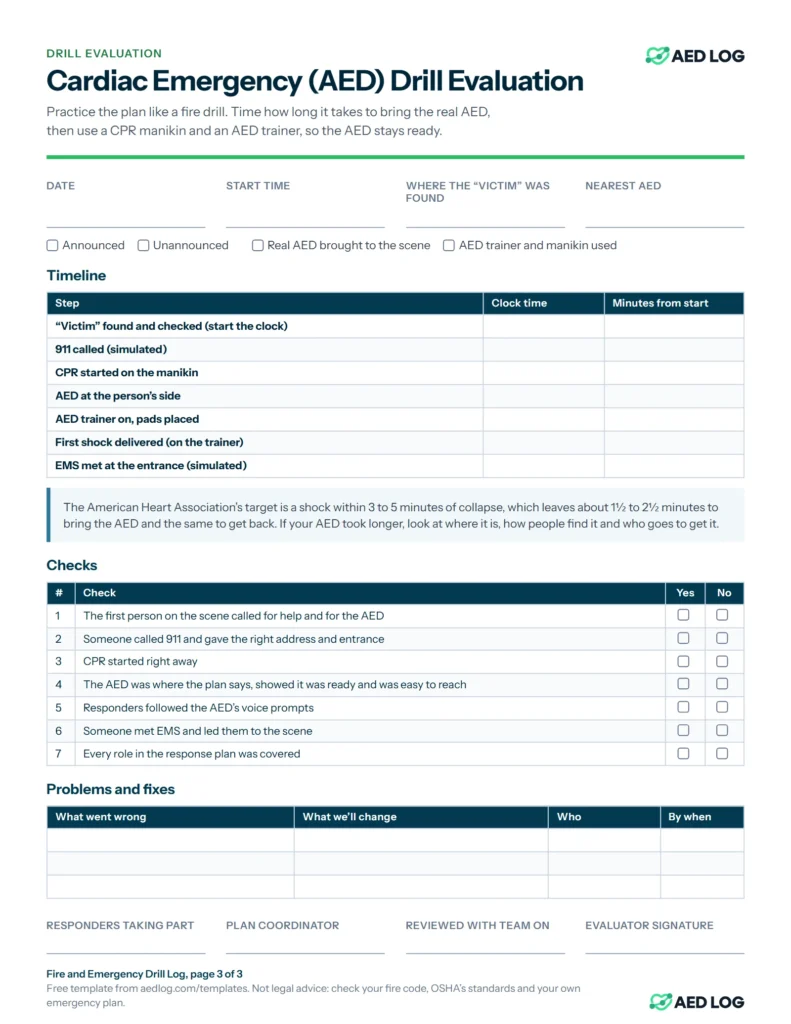
The American Heart Association’s checklist for cardiac emergency response plans includes practicing the plan with regular drills, the same way schools practice fire and lockdown drills. Its 2023 AED implementation guide sets the target the drill measures: a shock within 3 to 5 minutes of collapse, which leaves about 1½ to 2½ minutes to bring the AED and the same to get back. OSHA notes that the chance of surviving sudden cardiac arrest falls by 7 to 10 percent for every minute without CPR or defibrillation.
Run the drill with a stopwatch. Have someone “find” a CPR manikin in a realistic spot, then time each step on page three of the PDF: the 911 call, the start of CPR, the AED arriving, the pads going on and the first shock. Bring the real AED from its cabinet so the walk is timed honestly, but use an AED trainer on the manikin, so the real AED stays sealed, charged and ready. If the AED took longer than the target, the fix is usually where it’s mounted, how people find it or who is assigned to fetch it. Our AED placement guide covers how to close that gap.
Write the drill into your cardiac emergency response plan, which has its own drill section, and check your state: some school laws require cardiac drills. See AED laws for schools by state for what each state asks of schools.
Keep the equipment in your drills ready
A drill only proves the plan works if the equipment does. AED Log inspects every AED, fire extinguisher, first aid cabinet and eyewash station on schedule and keeps responders’ certifications current.
- Monthly AED inspections, with pad and battery expirations tracked and alerts before they lapse.
- Monthly fire extinguisher checks, with the annual service and hydrostatic test dates.
- Every responder’s CPR and AED certification, with a reminder before it expires.
- A document library for your emergency plan and drill records, with an expiration date to prompt the yearly review.
See AED Log’s features and the equipment it tracks, or start with our other free inspection templates.